Constraint Elimination Proof

142 of 144 Frameworks Failed

To organize 64 codons systematically, each amino acid's codons must group together. This requirement eliminates nearly every possible framework.

UCAG 4×16×1 is the unique solution

See the Proof Read the Paper

The Discovery

Systematic organization of 64 codons requires grouping. Once you require grouping, only one framework survives.

The Requirement

To organize codons systematically, amino acids with multiple codons must have those codons grouped together. Leucine has 6 codons - they must form a block. Methionine has 1 codon - it must separate from Isoleucine's 3 codons.

The Test

144 possible frameworks: 6 ways to weight positions × 24 ways to order nucleotides. Each tested against the grouping requirement.

The Result

Only UCAG ordering with 4×16×1 weighting creates proper grouping. Formula: CA = 4×1st + 16×2nd + 3rd. Everything else scatters amino acids across the coordinate space.

Why 142 Failed

Wrong weights: 5 of 6 weighting patterns break six-codon Leucine into separate fragments instead of one block.

Wrong order: Of 24 nucleotide orderings, only UCAG (and its mirror GACU) keeps all amino acid codons properly grouped. The other 22 scatter them.

Result: 142 frameworks eliminated. UCAG 4×16×1 is the unique solution.

What This Produces

UCAG 4×16×1 generates a three-dimensional coordinate system organizing all 64 codons as a 4×4×4 cube

The Cube Structure

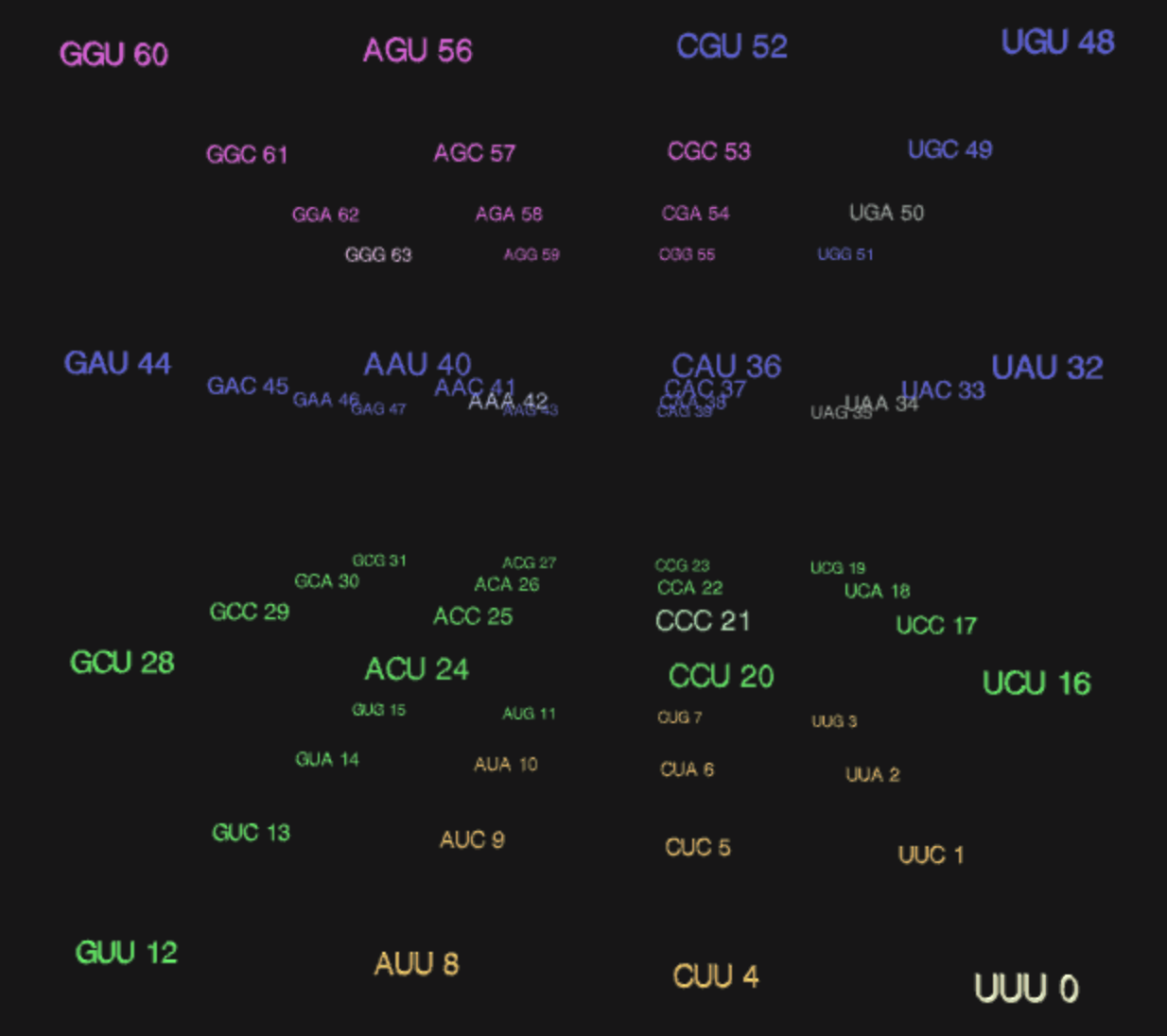
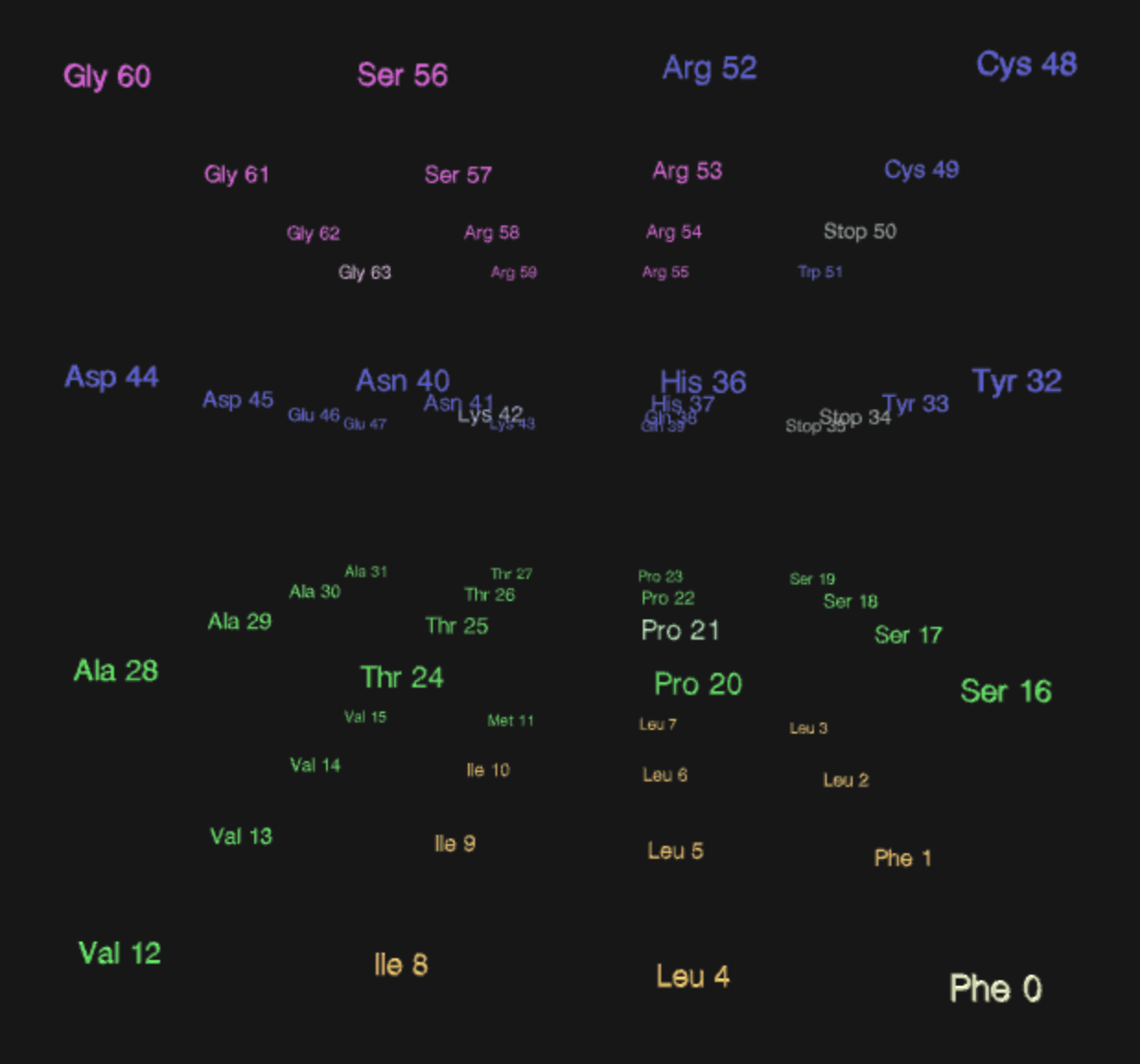
Every codon maps to coordinates 0-63. Four homo-nucleotide codons (UUU, CCC, AAA, GGG) anchor the main diagonal at positions 0, 21, 42, 63.

Single nucleotide mutations produce predictable coordinate changes: ΔCA = ±1, ±4, or ±16. This is Gray code adjacency — single-bit changes in quaternary notation.

19 of 20 amino acids have all codons within a single plane (same middle nucleotide). Natural boundaries at 10/11, 31/32, and 52/53 create four functional domains.

  The 4×4×4 Cube · Coordinate Addresses

  z=3 │ 48 49 50 51 │ 52 53 54 55 │ 56 57 58 59 │ 60 61 62 63
  z=2 │ 32 33 34 35 │ 36 37 38 39 │ 40 41 42 43 │ 44 45 46 47
  z=1 │ 16 17 18 19 │ 20 21 22 23 │ 24 25 26 27 │ 28 29 30 31
  z=0 │  0  1  2  3 │  4  5  6  7 │  8  9 10 11 │ 12 13 14 15

  Diagonal: UUU(0) → CCC(21) → AAA(42) → GGG(63)
  
  Four Planes (by middle nucleotide):
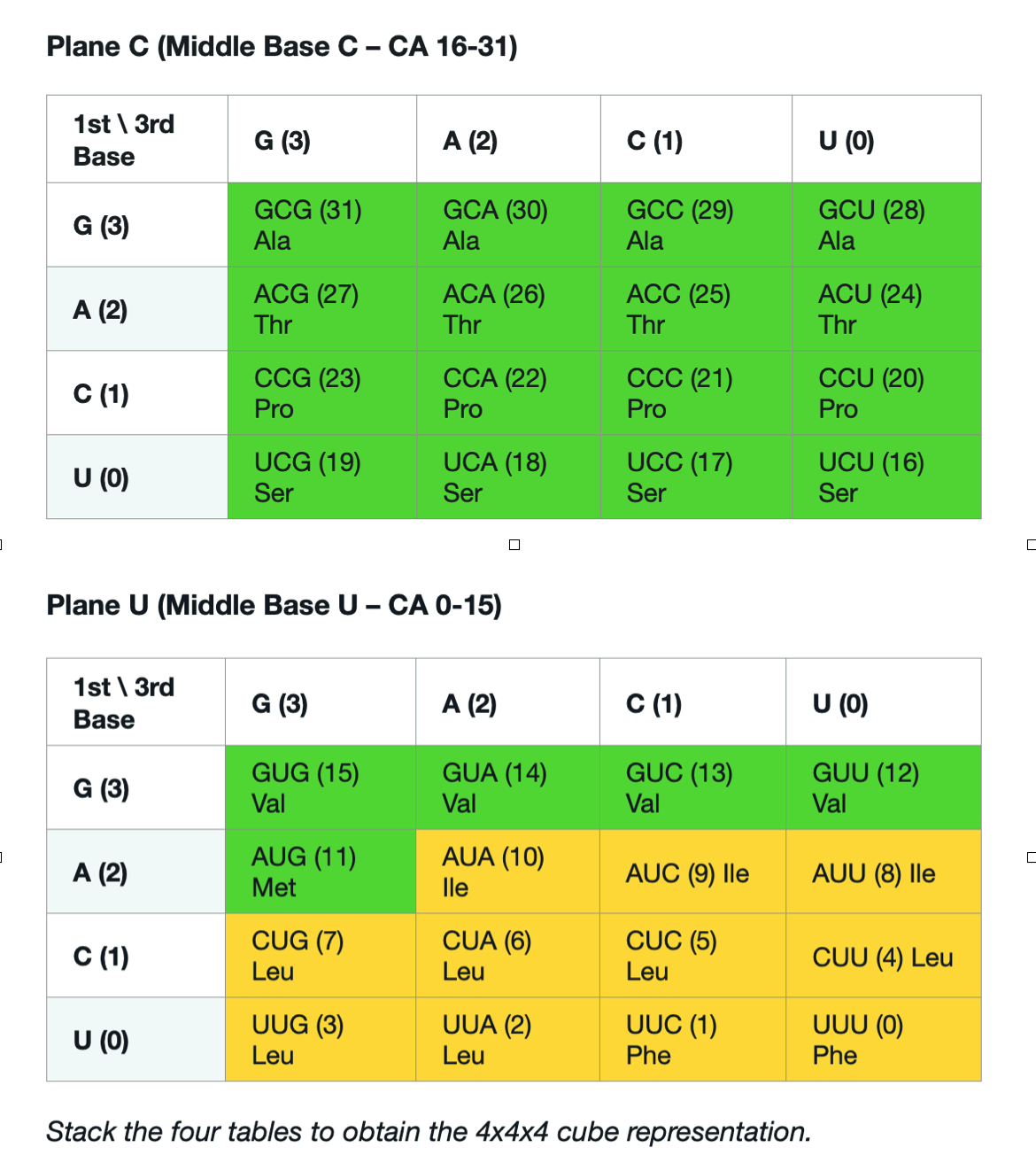
  U-Level: 0-15   │  Foundation Domain (0-10)
  C-Level: 16-31  │  Control Domain (11-31)
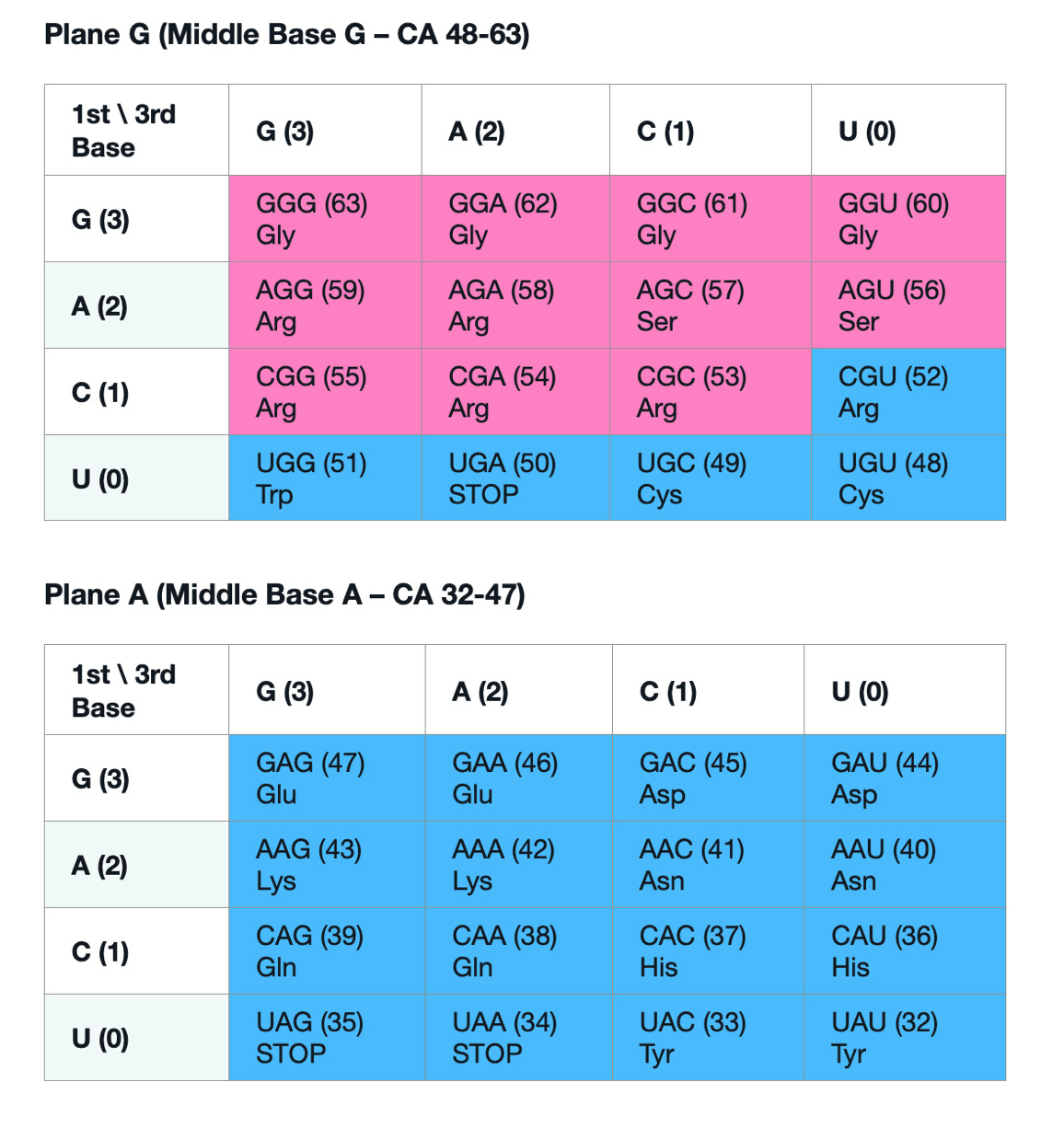
  A-Level: 32-47  │  Chemistry Domain (32-52)
  G-Level: 48-63  │  Adaptation Domain (53-63)

Gray Code Adjacency

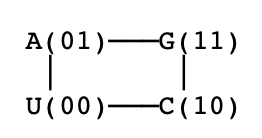
Adjacent codons differ by exactly one nucleotide. This emerges automatically from UCAG ordering — not imposed.

Domain Formation

Chemistry Domain (32-52): 50% of amino acids, 100% of STOP codons, all charged/aromatic residues. Probability by chance: <0.002%

Predictive Power

Coordinate distances correlate with biology: pathogenic mutations average ΔCA=17.3 vs benign at ΔCA=8.1

Species Validation

Bacterial codon usage shows systematic preferences for CGU(52) at the Chemistry/Adaptation boundary — exactly where the framework predicts optimization

RNAcube showing all 64 codons organized by coordinate address
Codons by coordinate address
RNAcube showing amino acid assignments across the cube
Amino acid assignments

Why Only This Framework Works

The companion paper proves that four axioms generate all architectural properties with zero biological input

From Constraint to Architecture

UCAG 4×16×1 isn't just the unique solution — it's mathematically inevitable. Four fundamental axioms force every structural property.

This produces self-referential coordinates (each codon's middle nucleotide establishes its own reference), binary family structure (pyrimidine/purine groupings), operator non-commutation (HV ≠ VH in the unfolded lattice), and compensation architecture (systematic balance across domains).

The constraints that eliminated 142 frameworks are the same constraints imposed by wobble tRNA biochemistry. Evolution discovered the only ordering compatible with the translational machinery it was building.

AXIOM 1

Binary Encoding

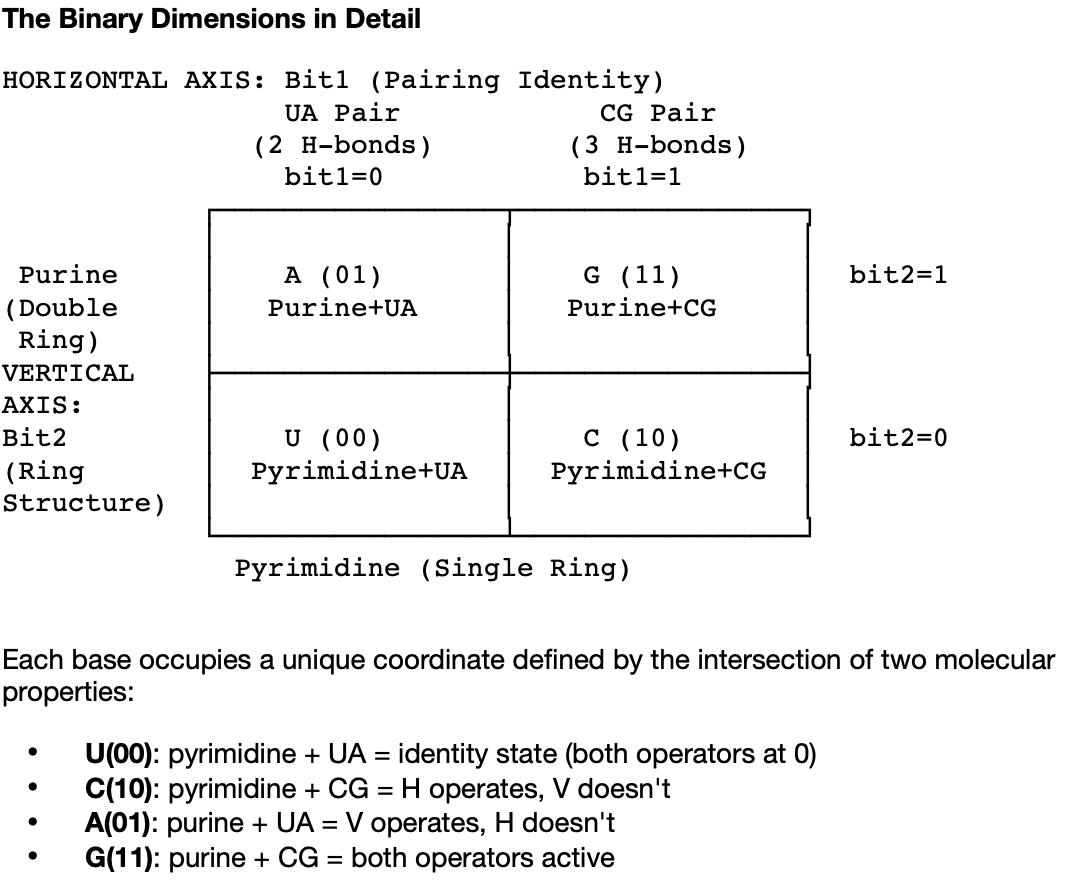
Four molecular states (U, C, A, G) require binary representation in quaternary base

AXIOM 2

Triplet Structure

Three-position reading creates 64 unique addresses requiring 4×4×4 organization

AXIOM 3

Positional Asymmetry

Middle nucleotide dominance (weight 16) emerges from consecutive serialization requirement

AXIOM 4

Single-Feature Adjacency

Wobble compatibility demands pyrimidines adjacent, purines adjacent — forces UCAG ordering

The Four Planes

Each plane contains 16 codons sharing the same middle nucleotide. 19 of 20 amino acids have all their codons within a single plane.

A-Level (CA 32-47) and G-Level (CA 48-63) showing Chemistry and Adaptation domains
U-Level (CA 0-15) and C-Level (CA 16-31) showing Foundation and Control domains

Research & Tools

The proof, its consequences, and interactive exploration

Foundation Paper

Mathematical Coordinate System for Analyzing Genetic Code Organization Patterns

The complete constraint elimination proof. 144 frameworks tested, 142 eliminated. The surviving coordinate system and its experimental validation.

Access on Figshare
Companion Paper

Mathematical Optimization in the Genetic Code Architecture

Four axioms generate 12 forced architectural properties: self-referential coordinates, binary family structure, operator non-commutation, and compensation architecture. Zero biological input.

Access on Figshare
Interactive

3D Visualization

Explore the 4×4×4 cube. Rotate, zoom, and examine how 64 codons organize in three-dimensional space with domain segregation.

Launch Viewer
Analysis

Variant Analysis Tool

Calculate coordinate addresses and distances for genetic variants. Batch processing supported. Pathogenic mutations average ΔCA=17.3 vs benign at 8.1.

Open Tool